
WELCOME BONUS 300%
UP TO €2000 + 100
FREE SPINS
UP TO €2000 + 100
FREE SPINS
Home → Blackjack
Blackjack at The Boss Casino: Variants, Rules and Payouts
The Shoe, the Cut Card and 75% Penetration
The shoe at a live blackjack table holds six to eight decks, and the cut card is placed by the dealer to mark where the shoe ends. A shoe with 75 percent penetration means three quarters of the cards are dealt before the dealer reshuffles, leaving one quarter behind the cut card.
Penetration matters because deeper penetration gives more exposed cards before a reshuffle. Card counters watch for a true count of at least +3 before taking the insurance side bet, which pays 2:1 but carries a house edge of 7.47% in a six-to-eight-deck game.
For a basic strategy player the cut card has no practical effect on the long-run return. Blackjack single deck with classic 3:2 rules still shows an RTP of 99.85% and a house edge of 0.15%, but a 6:5 payout on six decks lifts the house edge to 1.85% regardless of penetration.
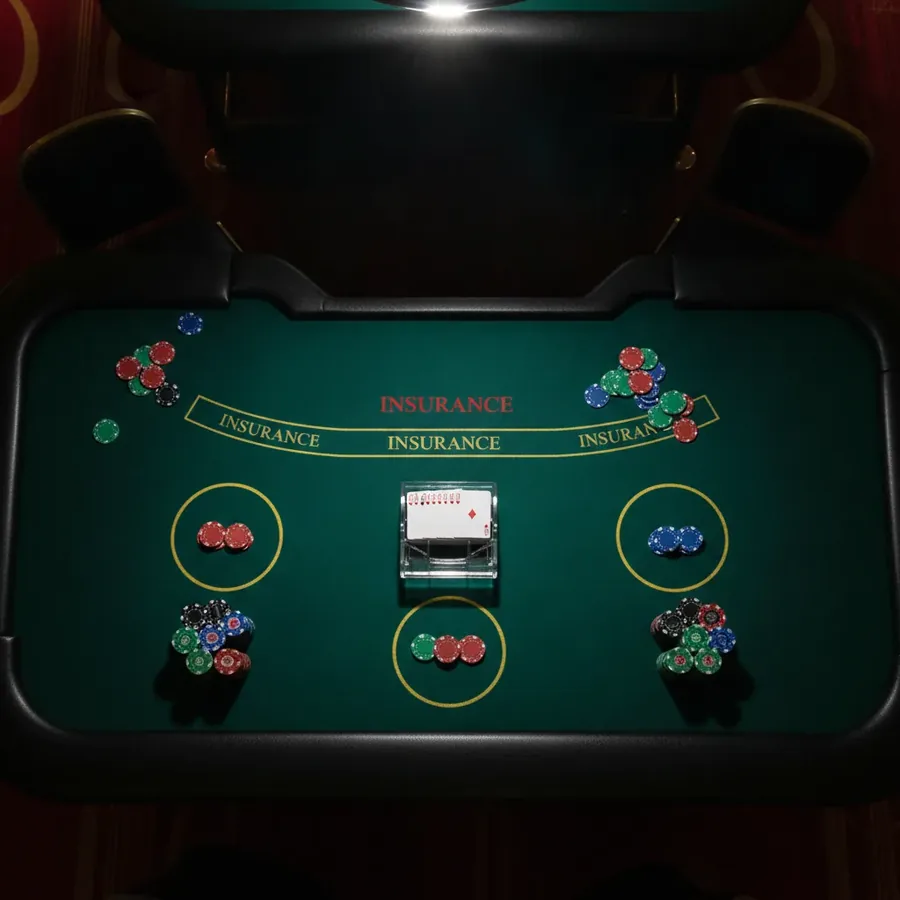
Clicked Too Late? The Hand Stands Automatically
In live blackjack, the decision timer is the hard boundary between a considered move and an automatic one. A player who does not act before the clock runs down loses the chance to hit, stand, double or split on that hand. The software then applies the default action for the table, which is to stand, so the hand is never folded or forfeited because time expired.
The automatic stand changes the practical return of a hand when a player would otherwise have drawn a card. For example, a blackjack table with six decks, the dealer standing on soft 17 and a 3:2 payout carries a house edge of 0.46% only when the player follows basic strategy on every decision. A forced stand on a hand that basic strategy says to hit pushes the actual result below that figure, because the player now plays two different strategies in one shoe.
The rule matters most at tables with unlimited seats, where the software must keep dozens or hundreds of hands moving on one shared timer. Evolution's Infinite Blackjack and Lightning Blackjack run this format, and a late click there simply locks the hand as it lies. On those tables the side bets and Lightning multipliers still settle according to their own rules, but the main hand receives no further cards after the timer ends.
Double Down or Just Hit on 11
A double down on 11 places an extra stake equal to the original bet and draws exactly one card. If the hand wins, the player collects 1:1 on both stakes; if it loses, both stakes are lost. This is the standard double down rule in the six-deck S17 game with DAS and DOA, where the RTP is 99.54%.
Doubling after a split is a separate modifier worth about 0.14 percentage points in RTP. On a €10 bet, a double down on 11 risks €20 instead of €10, but the extra stake is only placed when the player holds the strongest drawing hand against a weak dealer upcard.
A simple hit on 11 draws one card for the original stake only. The difference is that a double down caps the hand at one card while doubling the potential win, so the decision must be made before the draw. In the liberal Vegas Strip set with an RTP of 99.72%, the double down is part of the optimal strategy.
Splitting at a Live Table, Step by Step
A split at the live table starts when the first two cards are a pair. The player places an additional stake equal to the original bet, and the dealer separates the pair into two independent hands. Up to four hands can be created from repeated splits, though split aces usually receive only one card each.
Doubling after a split is allowed in the six-deck S17 game with DOA, and it improves RTP by about 0.14 percentage points. Resplitting aces is worth about 0.08 percentage points, while dealer hitting soft 17 lowers RTP by 0.22 percentage points, so the split rules directly offset or worsen the base return.
After the split, each hand is played out in turn using the normal decisions: hit, stand, double or split again. The liberal Vegas Strip rules with S17, DAS, resplit and late surrender produce an RTP of 99.72% and a house edge of 0.28%, the most player-friendly set among the listed variants.
Blackjack variants at a glance
| Variant | Payout | House edge | Rule | RTP |
|---|---|---|---|---|
| Blackjack Surrender (late surrender) – rule effect | 50% of the stake returned | −0.08 percentage points | The player gives up the hand after the dealer has checked for blackjack and loses half the stake. Improves RTP by about 0.08 percentage points. Early surrender is worth much more (up to −0.6 percentage points) but is extremely rare. | n/a (rule modifier) |
| Blackjack Split / double / H17 – rule effects | Double – stake ×2 with one card; split – up to 4 hands; split aces usually get one card each. | H17 +0.22 percentage points; RSA −0.08 percentage points; DAS −0.14 percentage points | Dealer hitting soft 17 lowers RTP by 0.22 percentage points; resplitting aces improves it by 0.08 percentage points; doubling after a split improves it by about 0.14 percentage points; 6 decks instead of 8 – about 0.02 percentage points. | n/a (rule modifiers) |
| Blackjack Single deck, classic rules, 3:2 | Blackjack 3:2, win 1:1 | 0.15% | Fewer decks = lower edge; one deck gives about −0.48 percentage points compared with 8 decks. Often offset by a 6:5 payout. | 99.85% |
| Blackjack Insurance (6–8 decks) | Insurance 2:1 | 7.47% | Separate side bet of up to 50% of the main bet when the dealer shows an ace. Basic strategy ALWAYS declines it (except for card counters at a true count ≥ +3). With a single deck the edge is ≈ 5.88% | 92.53% |
| Blackjack Liberal Vegas Strip (liberal rules, 3:2) | Blackjack 3:2, win 1:1 | 0.28% | The most player-friendly rule set: S17 + DAS + resplit + late surrender. Standard deviation 1.15 | 99.72% |
| Blackjack 6:5 payout instead of 3:2 (6 decks) | Blackjack 6:5, win 1:1 | 1.85% | Replacing 3:2 with 6:5 adds exactly +1.39 percentage points to the casino's edge – more than any other rule change. On a €10 bet a blackjack pays €12 instead of €15. | 98.15% |
Stop the Session After a 30 Percent Loss
A stop-loss point of 30 percent on a live blackjack buy-in means leaving the table once the session balance has fallen by that share. On a 100 € buy-in, the stop is reached at a loss of 30 €, leaving 70 € unspent. The player then closes the live dealer game instead of depositing again in the same sitting.
The practical effect is easiest to see against a table with a 1.00 € minimum, such as Evolution's Blackjack Party. A 30 € loss at that table equals 30 minimum bets, after which the session ends by rule. The same stop applied at Infinite Blackjack, with a 1 € minimum and a 5,000 € maximum, still means no chase after the 30 percent line is crossed.
A fixed stop-loss does not change the house edge of any variant. Blackjack with 6 decks, S17, DAS, DOA and a 3:2 payout keeps an RTP of 99.54% and a house edge of 0.46% whether the player stops at 30 percent or continues. The stop only limits the amount exposed to that edge in one run.
Insurance vs Even Money When You Hold Blackjack
Insurance is a separate side bet of up to 50% of the main bet when the dealer shows an ace, paying 2:1. On a 100 € blackjack hand, taking full insurance costs 50 € and pays 100 € if the dealer has blackjack. With 6 to 8 decks the insurance side bet carries an RTP of 92.53% and a house edge of 7.47%.
Even money is the same wager offered when the player already holds a blackjack against a dealer ace. The player locks in a 1:1 win instead of risking a push, but the cost is identical to buying insurance. Basic strategy always declines insurance on ordinary hands, and even money is declined for the same reason: the 7.47% house edge is far higher than the 0.46% edge of the main 6-deck S17 game.
Only a card counter at a true count of +3 or higher has a reason to take insurance, because the remaining deck is rich enough in ten-value cards to flip the edge. For everyone else, including players at Lightning Blackjack with its 99.56% RTP, declining insurance and accepting the 3:2 payout on a natural is the better long-run line.
When Can You Raise Your Bet?
A bet increase during the hand comes only through doubling, which requires a second stake of the same size and then exactly one further card. In Blackjack 6 decks, S17, DAS, DOA, the player may double on any first two cards, and doubling after a split is also allowed. That rule improves RTP by about 0.14 percentage points compared with tables that do not permit it.
Splitting is the other way to put more money on a hand, creating up to four hands from one starting pair. Resplitting aces improves RTP by 0.08 percentage points, but at most tables split aces get only one card each. A player on a 10 € hand who splits once and doubles one of the new hands has moved from 10 € to 30 € in total stakes.
Raising the base bet before the cards are dealt is a separate decision and is not a rule advantage. The house edge of 0.46% on the 6-deck S17 game, or the 99.47% RTP on Infinite Blackjack, applies to every euro staked. A larger wager simply multiplies the same long-run cost per hand, without any change in the odds.
Early Surrender Is Gone From Many Tables
Late surrender lets the player give up the hand after the dealer has checked for blackjack and lose half the stake, returning 50% of the bet. The rule improves RTP by about 0.08 percentage points. Early surrender, where the player can fold before the dealer checks, is much stronger, improving RTP by up to 0.6 percentage points, but it is extremely rare on live tables.
The gap between the two forms is large. A player facing a weak hand against a dealer ten saves 50% of the stake with late surrender, while early surrender can save the full stake when the dealer later gets blackjack. Because of that value, casinos remove early surrender from most live blackjack tables and keep only the late version where it appears at all.
At a table with 6 decks, S17, DAS and DOA, the base house edge is 0.46%. Late surrender reduces that edge to about 0.38% in the long run. A player who uses the option on hard 16 against a 10 is not chasing a win but cutting the average cost of a bad spot.
Surrender or Play On With 16 Against a 10
On a hard 16 against a dealer 10, late surrender costs exactly 50% of the stake. A 10 € bet loses 5 € and the player leaves the hand. Playing out the hand risks the full 10 €, and the player must draw with a high chance of busting a 16. The surrender rule improves RTP by about 0.08 percentage points.
The arithmetic is straightforward under the standard S17 game with a 0.46% house edge. Late surrender lowers the expected cost of this specific hand by about 0.08 percentage points in the long run, which is small but real. On 100 € of stakes, that is roughly 0.08 € of saved edge, multiplied over every time the bad spot appears.
The option is only available where the table keeps late surrender. Early surrender is removed from many live tables, so the realistic choice on 16 versus 10 is between late surrender and playing out. Basic strategy takes the surrender when the rules allow it, because half a stake lost is better than the larger average loss from drawing.
What a Natural Blackjack Actually Pays
A natural blackjack under the 3:2 payout pays 150 EUR on a 100 EUR stake, while the same hand under 6:5 returns only 120 EUR. That difference is exactly 30 EUR per 100 EUR staked on every winning blackjack. Replacing 3:2 with 6:5 adds 1.39 percentage points to the casino's edge, which is more than any other rule change on the table.
Blackjack Liberal Vegas Strip keeps the 3:2 payout and pairs it with the most player-friendly rule set: the dealer stands on soft 17, doubling after a split is allowed, resplitting is allowed, and late surrender is available. The resulting house edge is 0.28%, with an RTP of 99.72%. A player at this table loses an average of 28 cents per 100 EUR staked.
The practical effect of the payout switch becomes clear on repeated naturals. Ten blackjacks at 100 EUR each pay 1,500 EUR at 3:2, but only 1,200 EUR at 6:5, a shortfall of 300 EUR. The 6:5 variant carries an RTP of 98.15% against the classic single-deck 3:2 game at 99.85%, so the payout change outweighs the benefit of fewer decks.
Infinite Blackjack vs the Classic Seven-Seat Table
Evolution's Infinite Blackjack removes the seat limit and accepts an unlimited number of players at a single table, with a bet range of 1 to 5,000 EUR. The game carries an RTP of 99.47% and offers four side bets: Any Pair, 21+3, Hot 3 and Bust It. That puts the return just below the standard six-deck game with stand on soft 17, doubling after a split and doubling on any first two cards, which sits at 99.54%.
Its RTP is 99.56%, which is marginally above Infinite Blackjack by 0.09 percentage points. The multiplier mechanic changes the payout profile without moving the long-run return far from a classic table.
Blackjack Party from Evolution keeps a conventional single table with a bet range of 1.00 to 1,000 EUR and a party atmosphere with two hosts. A classic seven-seat table with six decks, S17, DAS, DOA and a 3:2 payout returns 99.54% under basic strategy. The unlimited variants do not require a seat, but the classic table's edge depends on the player following basic strategy on every hand.
Side Bets Raise the House Edge to 5%
Insurance is the most expensive side bet in the blackjack set, with a house edge of 7.47% and an RTP of 92.53% across six to eight decks. It is a separate bet of up to 50% of the main stake, offered when the dealer shows an ace, and pays 2:1. Basic strategy always declines it, except for card counters at a true count of +3 or higher.
A single-deck insurance bet lowers the edge to about 5.88%, but that is still far above any main-game blackjack variant in the comparison. The best main-game edge is 0.15% on single-deck classic rules with a 3:2 payout. Taking insurance on a 100 EUR main bet means risking 50 EUR on a side bet where the casino keeps 7.47% on average.
Infinite Blackjack bundles four side bets into the same interface: Any Pair, 21+3, Hot 3 and Bust It. None of these carries the low edge of the main game, and all raise the average cost per round. A player staking 10 EUR on the main bet and 5 EUR on a side bet at a 5% edge loses about 0.25 EUR on the side bet alone per round, before accounting for the main hand.
Place Side Bets Before the Cards Are Dealt
Every side bet in the blackjack set must be placed before the cards are dealt, alongside the main stake. Insurance is the exception in timing but not in principle: it is offered only after the dealer's upcard shows an ace, and the player may then add up to 50% of the main bet. The payout is 2:1, but the long-run cost is severe.
The four side bets in Infinite Blackjack follow the standard sequence: the player commits the side stake before any cards are visible. Once the deal starts, no side bet can be added or withdrawn. That timing rule applies to Any Pair, 21+3, Hot 3 and Bust It, and it locks in the higher house edge of the side-bet pool.
Basic strategy treats the timing as irrelevant for the main decision: a player should decline insurance whenever the true count is below +3, and should treat side bets as a separate, higher-cost wager. The main game in Blackjack Liberal Vegas Strip retains its 0.28% house edge only when the player avoids side bets and follows the liberal rules exactly.
Which Rule Variants the Software Shows
Blackjack Liberal Vegas Strip displays the most player-friendly rule set in the comparison: S17, doubling after a split, resplitting, and late surrender all active, with a 3:2 payout. The house edge is 0.28% and the RTP is 99.72%. Standard deviation is 1.15, which is a measure of how much session results swing around the average.
The six-deck standard table shows S17, DAS, DOA and a 3:2 payout, but no surrender. Its house edge is 0.46% with an RTP of 99.54%, provided the player follows basic strategy. Adding late surrender would improve the return by about 0.08 percentage points, while the dealer hitting soft 17 instead of standing would add 0.22 percentage points to the edge.
Rule modifiers can be read directly from the table settings. Doubling after a split improves RTP by about 0.14 percentage points, resplitting aces by 0.08 percentage points, and moving from eight decks to six decks by about 0.02 percentage points. A 6:5 payout instead of 3:2 is the single largest negative change, adding exactly 1.39 percentage points to the casino's edge.
Contact
Live - online chat
Banking









Providers












The Boss Casino 2026